
A pothole opened in a travel lane of a busy rural North Carolina road in July 2010. Water got into the surface and left a quarter-inch depression behind, too shallow for a conventional patch and deep enough to keep taking water. The NCDOT D5 Streets Maintenance crew filled it with a thin coat of Perma-Patch Regular Mix and ran a vibratory plate over it.
The problem: too shallow to cut out, too deep to leave
A quarter-inch depression is an awkward defect. It is not worth opening the lane for, so it usually gets left. But it holds water, and water in the surface is how a depression becomes a pothole again, then a bigger one.
- Below the threshold for a full repair. Not enough depth to justify a sawcut and removal.
- It holds water. Which is the mechanism that made the pothole in the first place.
- Live travel lane. On a busy rural road, with no long closure available.
The fix: a quarter inch, compacted in place
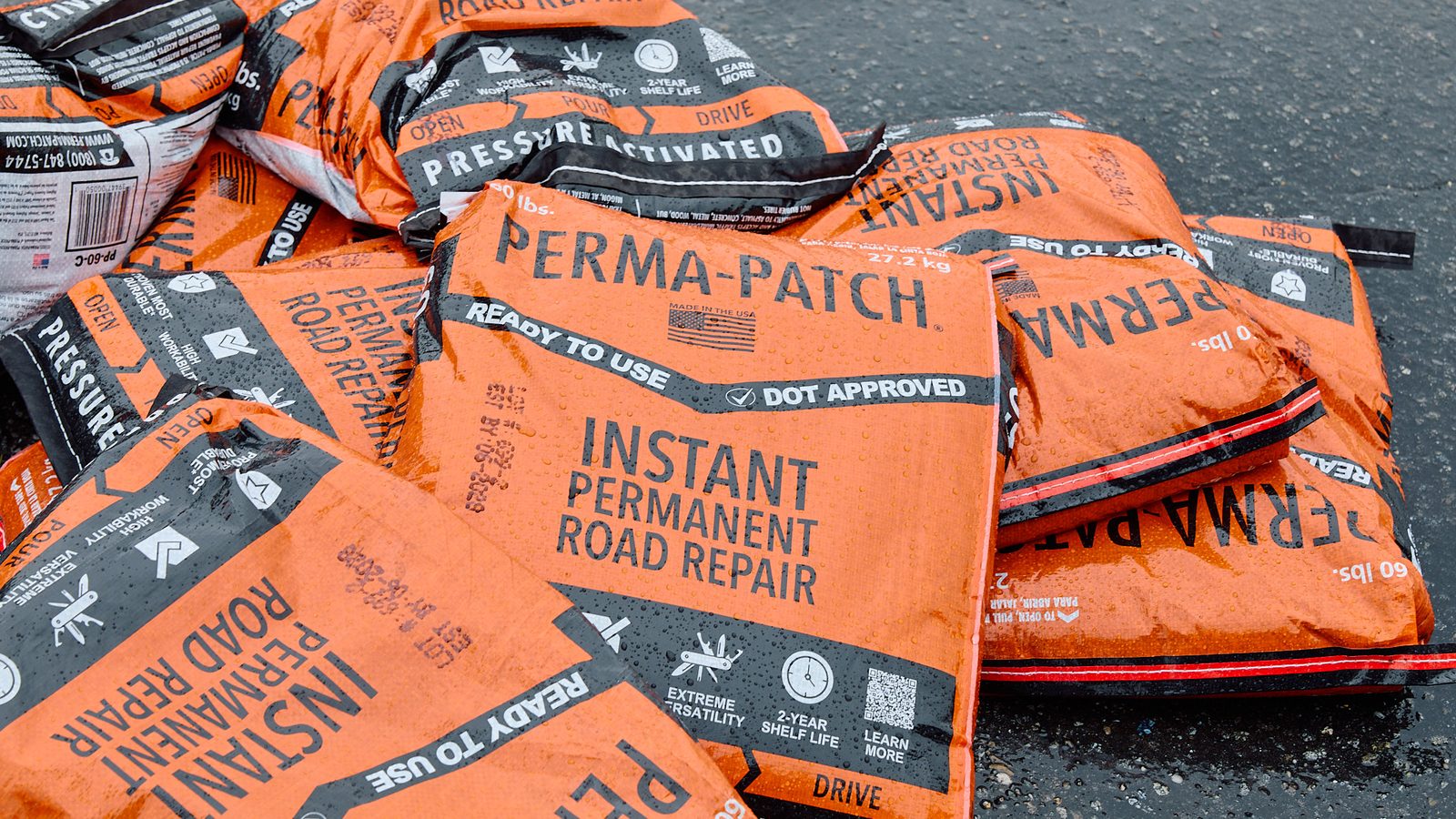
A quarter inch is the stated minimum application thickness for Perma-Patch Regular Mix, not a stretch of it. The aggregate is graded to a quarter inch and smaller, so a thin lift still keys together under a plate.
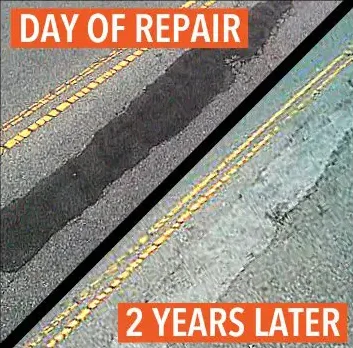
The D5 crew had used the material on other repairs already. They poured a thin coat over the depression and ran a vibratory plate compactor across it to seat it into a watertight bond with the surrounding surface. Two years later the repair was reported to still be holding.
Put it on the section you keep going back to.A rep in your area will follow up and have a sample shipped.
Request a sampleWhat the federal study found
The Strategic Highway Research Program put cold patch products on real roads and went back for four and a half years to count what was still there. Perma-Patch Regular Mix had the lowest failure rate of every product tested.
- Failed at 18 months
- 26% to 52%
- 18%
- Failed at 4.5 years
- 32% to 65%
- 22%
- Fills needed per 1,000 potholes, over 4.5 years
- 1,655 to 2,019
- 1,489
Federal Strategic Highway Research Program, National Research Council. Ranges cover premium bulk at the low end and bagged or local bulk at the high end. Full report at permapatch.com/shrp.
“A quarter inch is too shallow to patch. It will pop out.”
A quarter inch is the stated minimum application thickness, not an edge case. The aggregate is graded to a quarter inch and smaller so a thin lift still compacts, and the repair is pressure activated, it hardens under the plate rather than curing. The full spec is in the submittal package.
What crews ask about thin repairs
What temperature can crews work in?
Anywhere from −5°F to 105°F. No mixing, no tack coat, and no waiting for the material to come up to temperature.
How thin can it go?
A quarter inch is the minimum. There is no maximum depth, deep repairs just go in three-inch lifts.
When can traffic come back?
As soon as it is compacted. The material is pressure activated and hardens under compaction, so the passing traffic finishes the job.
Does the hole have to be dry?
No. It can be placed in water-filled holes.
What does it bond to?
Asphalt, concrete, steel and wood. It does not stick to rubber tires.
How much does a bag cover?
A 60 lb bag fills 0.48 cubic feet, about 6 square feet at an inch deep. Overfill by half to three quarters of an inch before compacting.
Related
Put it on your worst hole
Request a sample or an on-site demonstration and let the pavement decide.
Request a sample