
Case Study · Municipal
Most curb repairs mean calling a concrete contractor, waiting weeks, and pulling traffic while the patch cures. The Maryland Department of Transportation tested Perma-Patch Aqua™ on Pasadena’s worst curbs. Two field staff applied and compacted it the same day. No crew, no truck rental, no wait.
1–2 People
vs. a typical concrete crew of 4 to 6.
Instant
Open to traffic after compaction. Concrete: 7 to 10 days.
No Equipment Rental
Concrete jobs run $400 to $800 per job.
1 Pint
Water per 50 lb pail. No mixer, no heat, no cure to wait on.

Perma-Patch Aqua™ troweled to the saw cut, full length of the curb. Ready for water and compaction. Pasadena, Maryland.
The Problem: Concrete Is a Contractor Job
When a curb fails, spalling, cracking, sinking, the standard fix is concrete replacement. That means a contractor on the schedule weeks out, an equipment rental, a jobsite, and a closure while the concrete cures. For a public works department managing miles of curb with a small crew, every repair is downtime.
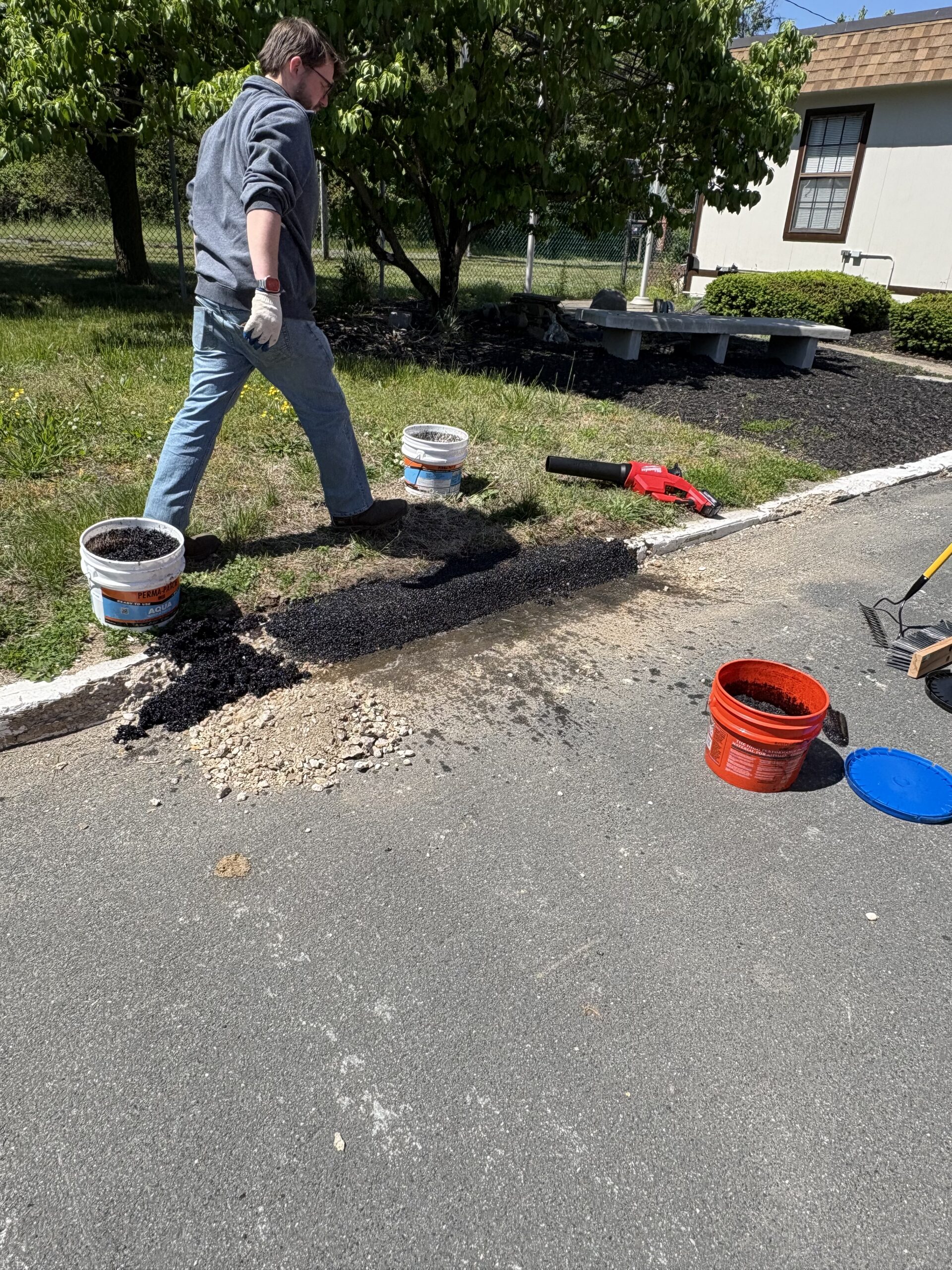
Aqua spread from the pail along the saw cut. Pails and a garden hose, that is the whole staging area.
Wet it. Set it. Forget it.
1. Saw Cut and Prep. The crew picked the worst curb sections in Pasadena and cut a clean perimeter. No special equipment, a standard concrete saw and hand tools.
2. Apply Perma-Patch Aqua™. Perma-Patch Aqua™ goes down straight from the pail. Spread it to the saw cut by hand or with a trowel. It bonds to concrete, asphalt, and aggregate base.
3. Add Water and Compact. One pint of water per 50 lb pail activates the polymer. A hand compactor seats it. The curb takes traffic as soon as compaction is done.
Put It on Your Worst Curb.
A rep in your area will follow up and have a sample shipped.
What the Product Sheet Says
These numbers are from the PPAQ-50-P product information sheet and SDS. The Pasadena curbs were done to this spec.
Spec
PPAQ-50-P product sheet
Water activation
1 pint per 50 lb pail, minimum
Traffic
Immediate after compaction
Bonds to
Concrete, asphalt, aggregate base, steel
Thickness
1/4 in minimum, 1/2 to 1 in typical
Coverage
About 5 sq ft per pail at 1 in depth
Approvals
DOT approved
VOC
Solvent free, no VOCs

Hand compactor and the last pail. Water goes on, compactor goes over it, section is open.
Ready When the Compactor Lifts
There is no cure to wait on. Water activates the polymer, the hand compactor seats it, and the section takes traffic. The crew did not set cones for the afternoon because there was nothing left to protect.
Concrete gives you neither. Seven days before traffic at the earliest, and a contractor who has to come back to strip the forms.
You can now get your own people on these curbs without calling a contractor.
“Water-activated patches pop out the same way concrete does. They will not hold.”
Perma-Patch Aqua™ is not concrete. The polymer lets it move with the road and with temperature swings instead of cracking, and the aggregate bonds directly into the asphalt and concrete around the repair. DOT approved.
Questions Crews Ask
How much water?
One pint per 50 lb pail, minimum. A garden hose works. More water does not hurt it.
Will it hold through winter?
The binder is polymer modified. It flexes with the pavement instead of cracking against it, which is what takes out rigid concrete patches in freeze-thaw.
Does it stick to concrete or only asphalt?
Both, plus aggregate base and steel. A curb face and an asphalt gutter get the same pail.
How thick can we go?
Quarter inch minimum. Typical field placement is 1/2 to 1 inch. Deeper than that, place it in lifts and compact each one.
What does one pail cover?
About 5 square feet at 1 inch. Measure the cut, figure the depth, round up a pail.
What is the shelf life?
One year from manufacture, stored dry and covered. Moisture is the trigger, so keep the pail sealed until you are at the curb.
Related
Product
Perma-Patch Aqua™ 50 lb Pail
Application
Parking Lots and Curb Lines
Next study
All Case Studies
Hand Your Engineer the Submittal Package
The Perma-Patch Aqua™ submittal package has the product information sheet, the SDS, and the application instructions in one PDF.