
Perma-Patch · Published August 17, 2026
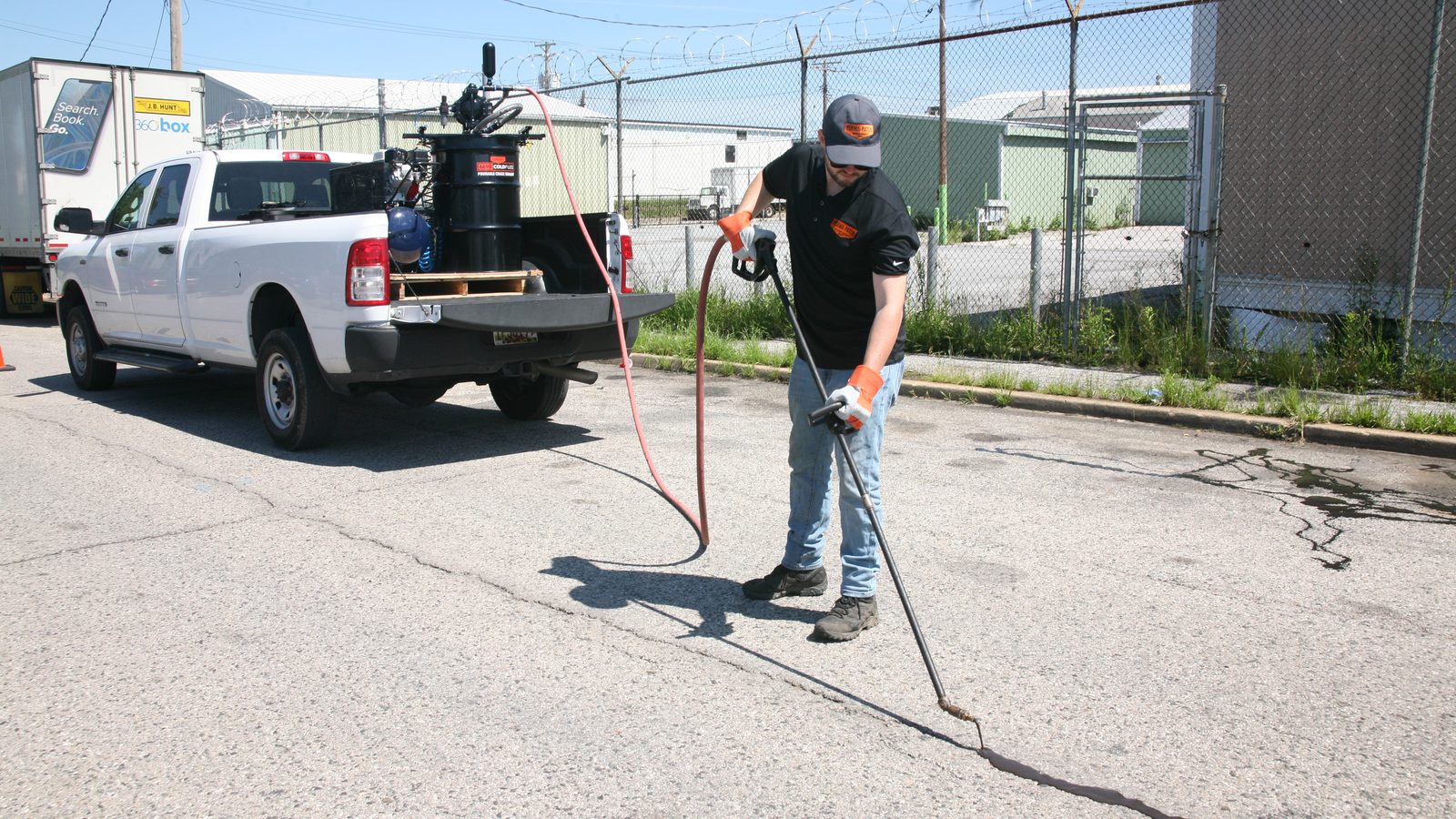
Case Study · MunicipalThe City of Lafayette maintained its streets with traditional hot-pour crack sealant. It worked, but every run meant a hot-melt kettle, a water truck to cool the material, extra crew to handle it safely, and setup time that made small jobs not worth the trip. The city switched to 6690 ColdFuze™ and the Pump and Wand System. The whole rig now rides in the bed of a pickup.
The problem: small jobs, big equipment
Lafayette’s maintenance list is mostly small, scattered work. A block here, a joint there, a lot at a city facility. Hot-pour crack sealing is built for the opposite of that. Every run, no matter how short, meant mobilizing the same equipment train and staffing it to work safely around material heated past 350°F.
- A hot-melt kettle and its support equipment
- A water truck to cool the material
- More personnel on site to run the operation safely
- Setup and cleanup time on both ends of every job
For a department whose list is mostly small jobs, the setup cost more time than the sealing did.
The fix: the rig fits in the truck
The city moved to 6690 ColdFuze™ with the Perma-Patch Pump and Wand System. The sealant goes down cold. There is no heating cycle to wait through at the start of the day and no kettle to scrape out at the end of it.
The compact system fits in the bed of a pickup, so crews respond to small jobs without hauling equipment or heating material. Crews seal at 40°F and above. Cracks do not need routing, the sealant needs no primer, and it self-levels, so there is no tooling step. A rubber V or U squeegee clears the excess and cleanup is water while the material is uncured.
One pump runs two wands and two squeegees at once, so the operation scales with people instead of with equipment. Traffic goes back on immediately under normal traffic control, which on a residential street means the crew is not holding a block while a joint cools.
Speccing it for a municipal program?The submittal package has the full D6690 and C920 test data, the SDS, and the product sheet.
Get the packageWhat an independent lab found
PRI Asphalt Technologies ran 6690 ColdFuze™ against ASTM D6690, the hot-applied crack sealant spec. Cold-applied material tested against the hot-pour standard, and these are the margins it cleared it by.
- Cone penetration, dmm at 25°C
- 90 max
- 25
- Softening point
- 170°F min
- >400°F
- Resilience
- 60% min
- 66%
- Bond, 3 cycles 50% extension at −29°C
- Pass
- Pass
- Asphalt compatibility
- Pass
- Pass
- Flow at 93.3°C
- 3 mm max
- No flow
Source: PRI Asphalt Technologies Test and Evaluation Report, 19 March 2024. AASHTO accredited, ISO/IEC 17025.
It also meets ASTM C920 Type S, Grade P, Use T, Class 50, which is the elastomeric joint sealant spec. 6690 ColdFuze™ is the only product that meets both. In C920 weathering, peel adhesion went up after 200 hours of UV exposure, from 12.9 lbf to 16.7 lbf dry.
The objection Lafayette had to answer first
“Cold pour can’t match hot-applied performance.”
6690 ColdFuze is tested against ASTM D6690, the hot-applied spec, and exceeds Type II with Type IV performance in extreme cold. The lab could not get the residue to soften at 400°F against a 170°F minimum. Those are the numbers your engineer wants, and they are in the submittal package.
Questions crews ask
Does it need a primer?
No. 6690 ColdFuze bonds to asphalt or concrete on its own. Backer rod is optional on cracks, used only when a crew wants to control depth and hold material usage down.
Does the crack have to be routed first?
No. Routing is not required. Crews clean the crack and seal it, which is most of why a small job stops needing a full mobilization.
How cold can crews apply it?
Down to 40°F. It also needs to be dry, with no rain in the forecast and no chance of a freeze within 24 hours of placement. Limited dampness inside the crack is tolerated.
How long before traffic goes back on it?
Immediately, under normal traffic control. The sealant does not have to cure first. Skin-over runs about 20 minutes and full cure takes 8 to 24 hours, but neither one holds the road.
Will it track or bleed in summer heat?
In lab testing the residue never reached a softening point when heated to 400°F, against a D6690 minimum of 170°F, and showed no flow at 93.3°C where the spec allows 3 mm.
What crack widths does it handle?
Up to 2 inches, or 50 mm. Depth to width should not exceed 2:1. Shape factor runs up to 1.5, against 1.0 for hot melt and 0.5 for silicone, so it tolerates more joint movement.
Does it leave a bead for the plow to catch?
No. It cures 1/4 to 3/8 inch below the pavement surface. There is no raised bead for a plow blade or a tire to catch, and no speed bump across the lane.
How far does a gallon go?
About 100 linear feet of a 1/2 by 1/2 inch reservoir per 1.3 gallons. One pump runs two wands and two squeegees at once, so output scales with crew rather than equipment.
What does cleanup look like at the end of a shift?
Water, while the material is still uncured. Paint thinner only if it has already dried. There is no kettle to scrape out and no hardened material to chip loose.
How is it packaged, and how long does it keep?
55 gallon drums, 5 gallon pails, and 1 gallon jugs four to a case. Shelf life is 12 months unopened, stored below 100°F, out of direct sun, and kept from freezing.
Is it approved for DOT work?
It meets ASTM D6690 and AASHTO M-301 Type II and is DOT approved. For shipping, the SDS lists it as non-flammable with no flash point, non-toxic, and DOT non-regulated.
Related
Hand your engineer the report
The 6690 ColdFuze™ submittal package has the full ASTM D6690 and C920 test data, the PRI lab report, the SDS, and the product sheet in one download.
Get the submittal package