
Watch how a course repair goes without a contractor, then request your sample below.
The same patch North Carolina DOT puts in I‑95 bridge joints is what we are handing to golf course superintendents. Lowest failure rate of every product tested in the federal SHRP study.
Tell us what you are repairing and your regional rep will call to size it before anything ships.
Why It Holds
Carts and cars go back on as soon as it is tamped
Perma‑Patch is pressure activated. It hardens by compaction, not by curing, so there is no waiting and nothing to cordon off. It also does not stick to rubber tires, which is the part that matters when a foursome comes through ten minutes later.
¼″ minimum, no maximum depth
Cart path edges ravel thin. Most cold patch cannot go below an inch without kicking out. Perma‑Patch goes down at a quarter inch, and in 3″ lifts for anything deeper. That thin end is what the NCDOT quarter‑inch depression study is about.
−5°F to 105°F, and it goes into standing water
Shoulder season frost mornings, after irrigation, after rain. You do not have to wait for the path to dry or for the weather to turn.
“We already buy cold patch. It kicks out by spring.”
Most of it does. In the federal Strategic Highway Research Program field trials, bagged cold patch failed at 52 percent inside 18 months and 65 percent by four and a half years. Perma‑Patch Regular Mix failed at 18 percent and 22 percent, the lowest failure rate of every product tested.
Where It Goes Besides Cart Paths
Service roads. Maintenance yard. Clubhouse approach and the member lot. Around drain grates and irrigation box lids, where the collar always breaks down first. Bridge and culvert approaches.
Same bag, same method.
Proven Most Durable
Per Federal Strategic Highway
Research Project “SHRP” Test.
High Workability
Open. Pour. Done.
Easy to use with no mixing or preparation.
Extreme Versatility
Handles your toughest applications.
Prevents water seepage.
2 Year Shelf Life
Always ready.
Keep on hand with no waste.
Accepts Traffic Immediately
No drying or curing time.
No closed roads or traffic tie-ups.
Bonds Permanently
To asphalt, concrete, steel,
wood, and other hard surfaces.
Applied in Water
Can be added to water-filled
potholes and areas.
All-Season
Works in all seasons and all climates.
Rated −5°F to 105°F.
Thin Application
Can be applied as thin as 1/4 inch.
Does not stick to rubber tires.
Open, Pour, Drive
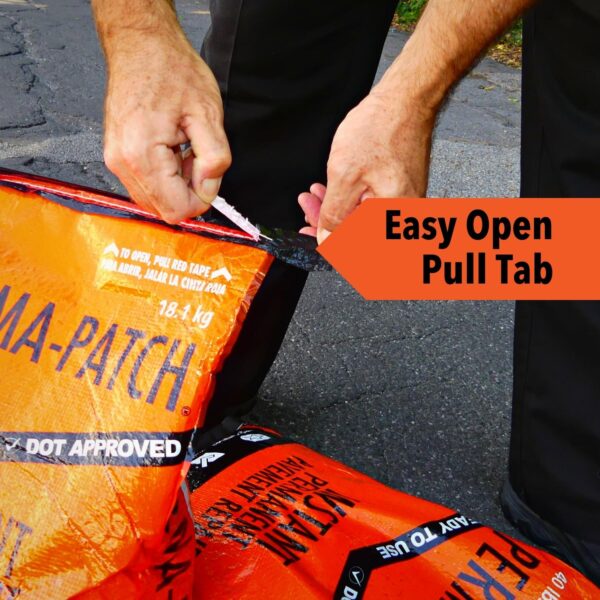
1. Open
Bags come with pull-tabs, allowing for fast and efficient opening.

2. Pour
Perma-Patch smoothly flows out of its packaging quickly and consistently.
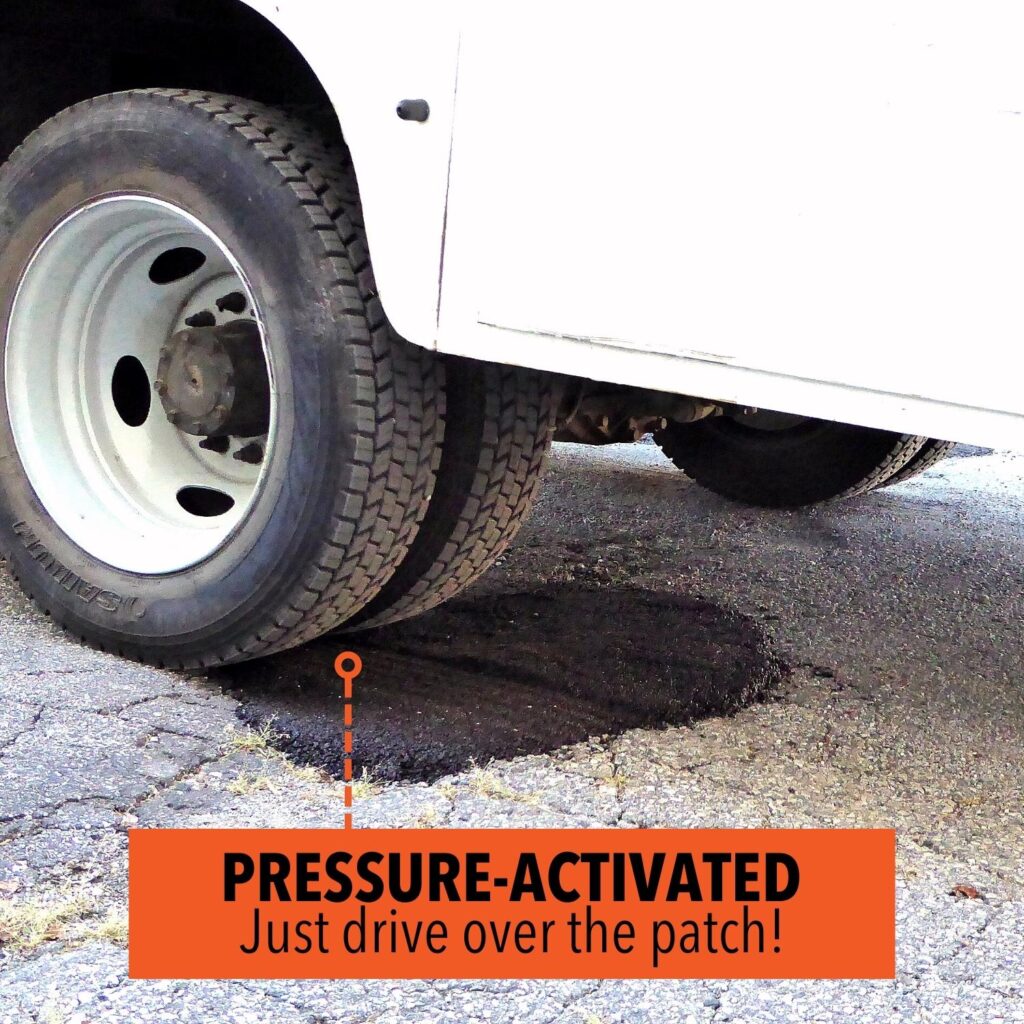
3. Drive
Use a tamper, or let a golf cart, UTV, or maintenance truck do the compacting.
Questions Superintendents Ask
Can my own crew do this, or do I need a paving contractor?
Your crew. Remove loose material, pour, overfill by half to three quarters of an inch, spread, compact. A hand tamper works. The passing weight of traffic will also compact it.
Do I have to close the path while it sets?
No. It hardens by compaction rather than curing, so it is ready for traffic as soon as it is tamped. It does not stick to rubber tires, so carts can roll over a fresh repair without picking it up or tracking it onto the green surrounds.
What if the path is wet, or it rained this morning?
It goes into a hole full of water. Application range is −5°F to 105°F, so frost mornings and shoulder season are both in range. You do not need to wait for the path to dry out or for a warm week.
How thin can it go? Our edges are more raveled than potholed.
¼″ minimum, which is thinner than most cold patch will hold at. There is no maximum depth, apply anything deeper in 3″ lifts. NCDOT used it on a quarter‑inch depression, which is the study linked above.
We buy once a season. Will it keep?
Shelf life is two years guaranteed. Bags are durable poly-woven BOPP.