
Case Study · Tollway
Perma-Patch · Published August 17, 2026
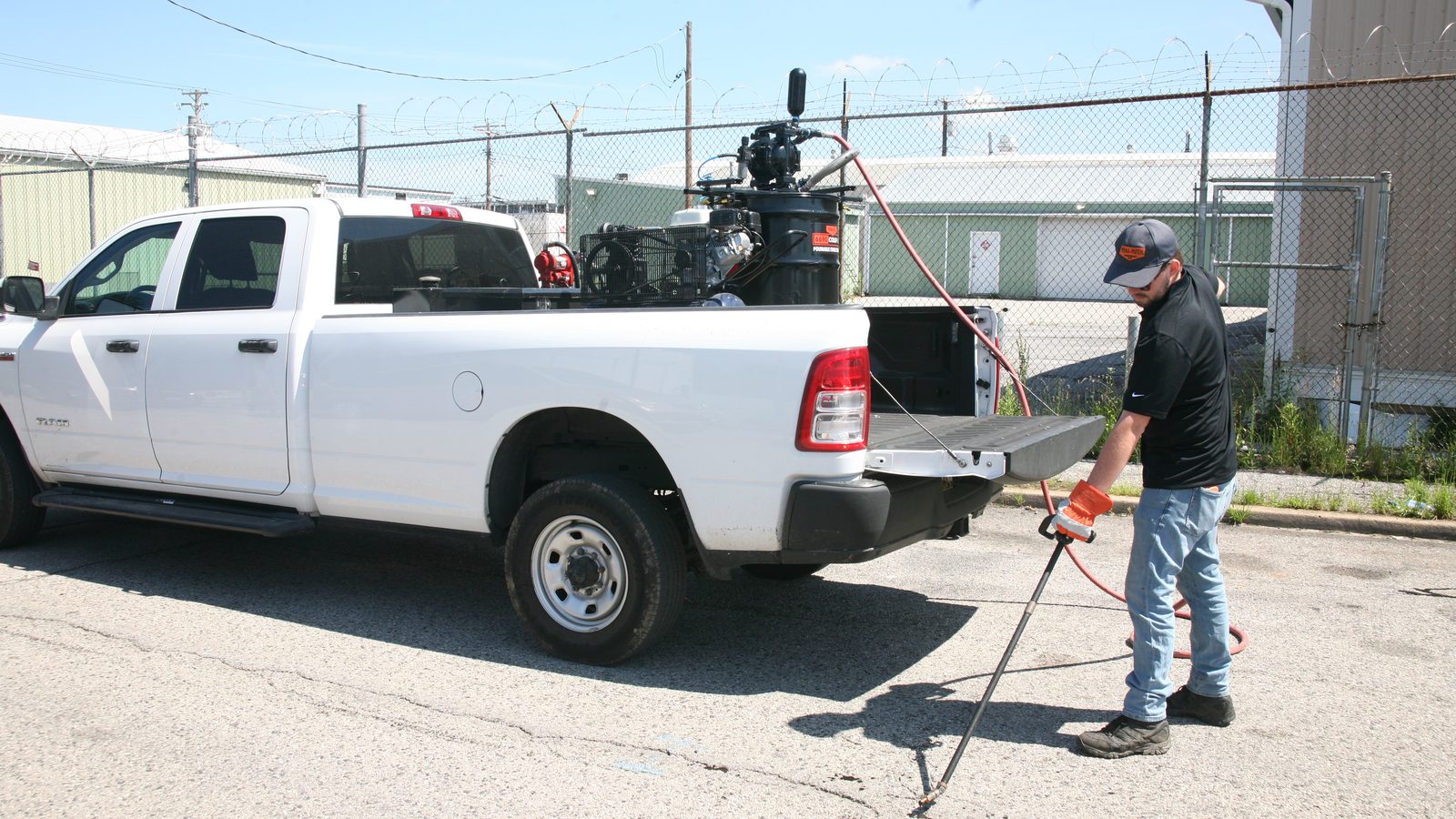
A North Texas Tollway Authority crew member suffered a burn working the hot kettle. That moved safety to the top of the list. NTTA adopted the 6690 ColdFuze™ System, a cold-applied sealant run through a portable pump, with no kettle, no flame, and no heated material. The time crews had spent heating and cleaning equipment went back into the work.
The problem: the kettle was the hazard
NTTA ran hot-pour crack sealing the way most agencies do, with a kettle bringing material past 350°F on an active roadway. A crew member was burned working that kettle. That ended the discussion about whether to keep running it.
The kettle was also costing the agency time on both ends of every shift, before anyone sealed a foot of crack and after the last one was done.
- Material past 350°F on a live roadway
- Burn exposure any time a crew worked the kettle
- Warm-up time before the crew could start
- Hardened material to chip out of equipment at shift end
The fix: take the heat out of the operation
NTTA adopted the 6690 ColdFuze System, a cold-applied crack sealant run through a portable pump. There is no kettle, no open flame, and no heated material anywhere in the operation. The SDS lists the product as non-flammable with no flash point, non-toxic, water soluble, and DOT non-regulated. Required PPE is gloves and eye protection.
Set-up runs about ten minutes. Crews are sealing shortly after they arrive and shut down when the work is done. Cleanup is water while the material is uncured, so nothing hardens inside equipment overnight. There is no kettle to chip out because there is no kettle.
Traffic returns immediately under normal traffic control. On a tollway that matters more than it does on a city street, because the lane closure itself is the expensive part of the job.
Running a safety review on hot-pour?The submittal package has the SDS, the independent lab report, and the full D6690 and C920 test data.
What an independent lab found
Removing the heat only helps if the cold-applied material holds up. PRI Asphalt Technologies ran 6690 ColdFuze™ against ASTM D6690, the hot-applied crack sealant spec.
- Cone penetration, dmm at 25°C
- 90 max
- 25
- Softening point
- 170°F min
- >400°F
- Resilience
- 60% min
- 66%
- Bond, 3 cycles 50% extension at −29°C
- Pass
- Pass
- Asphalt compatibility
- Pass
- Pass
- Flow at 93.3°C
- 3 mm max
- No flow
Source: PRI Asphalt Technologies Test and Evaluation Report, 19 March 2024. AASHTO accredited, ISO/IEC 17025.
It exceeds D6690 Type II with Type IV performance in extreme cold, and also meets ASTM C920 Type S, Grade P, Use T, Class 50. 6690 ColdFuze™ is the only product that meets both specs.
The objection every agency raises
“Safety switches always cost productivity.”
The kettle’s heat cycle was the productivity cost. Cold-applied crews are sealing about ten minutes after they arrive, shut down when the work is done, and clean up with water instead of chipping hardened material out of a kettle. One pump runs two wands and two squeegees at once, so throughput scales with people rather than equipment, and the lane opens immediately because the sealant does not have to cure first. The submittal package has the data behind that.
Questions safety officers ask
What PPE does the crew need?
Gloves and eye protection. The SDS lists 6690 ColdFuze as non-flammable with no flash point, non-toxic, and water soluble. With no heated material in the operation there is no thermal PPE requirement.
Is there any heated material anywhere in the process?
No. The sealant is applied cold through a portable pump and wand. Nothing is melted, nothing is held at temperature, and there is no open flame on the jobsite.
Are there fumes?
The product is water soluble and non-toxic, and there is no heating step to drive off vapor. Crews are not standing over a kettle, which is where the fume exposure in hot-pour work comes from.
How is it classified for transport?
DOT non-regulated, per the SDS. It is non-flammable with no flash point, so it does not carry the shipping and on-site storage restrictions that come with hot-applied materials.
How long does the lane stay closed after sealing?
Only as long as the crew is working in it. Traffic returns immediately under normal traffic control, with no cure time first. Skin-over runs about 20 minutes and full cure takes 8 to 24 hours, but neither holds the lane.
Does cold-applied hold up in the cold?
It exceeds ASTM D6690 Type II with Type IV performance in extreme cold, and passed bond testing at three cycles of 50 percent extension at −29°C. Application itself needs 40°F or above.
Will it soften or track in Texas summer heat?
In lab testing the residue never reached a softening point when heated to 400°F, against a D6690 minimum of 170°F, and showed no flow at 93.3°C where the spec allows 3 mm.
What happens to the equipment at the end of a shift?
Water cleanup while the material is uncured. Paint thinner only if it has dried. There is no kettle to scrape and nothing hardening inside equipment overnight, which removes the shutdown labor entirely.
Does it need routing or a primer first?
Neither. It bonds to asphalt or concrete on its own and routing is not required. Backer rod is optional, used only to control depth and material usage.
What crack widths does it handle?
Up to 2 inches, or 50 mm, with depth to width no more than 2:1. Shape factor runs up to 1.5, against 1.0 for hot melt and 0.5 for silicone.
Is it approved for DOT work?
It meets ASTM D6690 and AASHTO M-301 Type II and is DOT approved. The full test data and the independent lab report are in the submittal package.
Related
Hand your engineer the report
The 6690 ColdFuze™ submittal package has the full ASTM D6690 and C920 test data, the PRI lab report, the SDS, and the product sheet in one download.